# Prediction Markets - A Primer

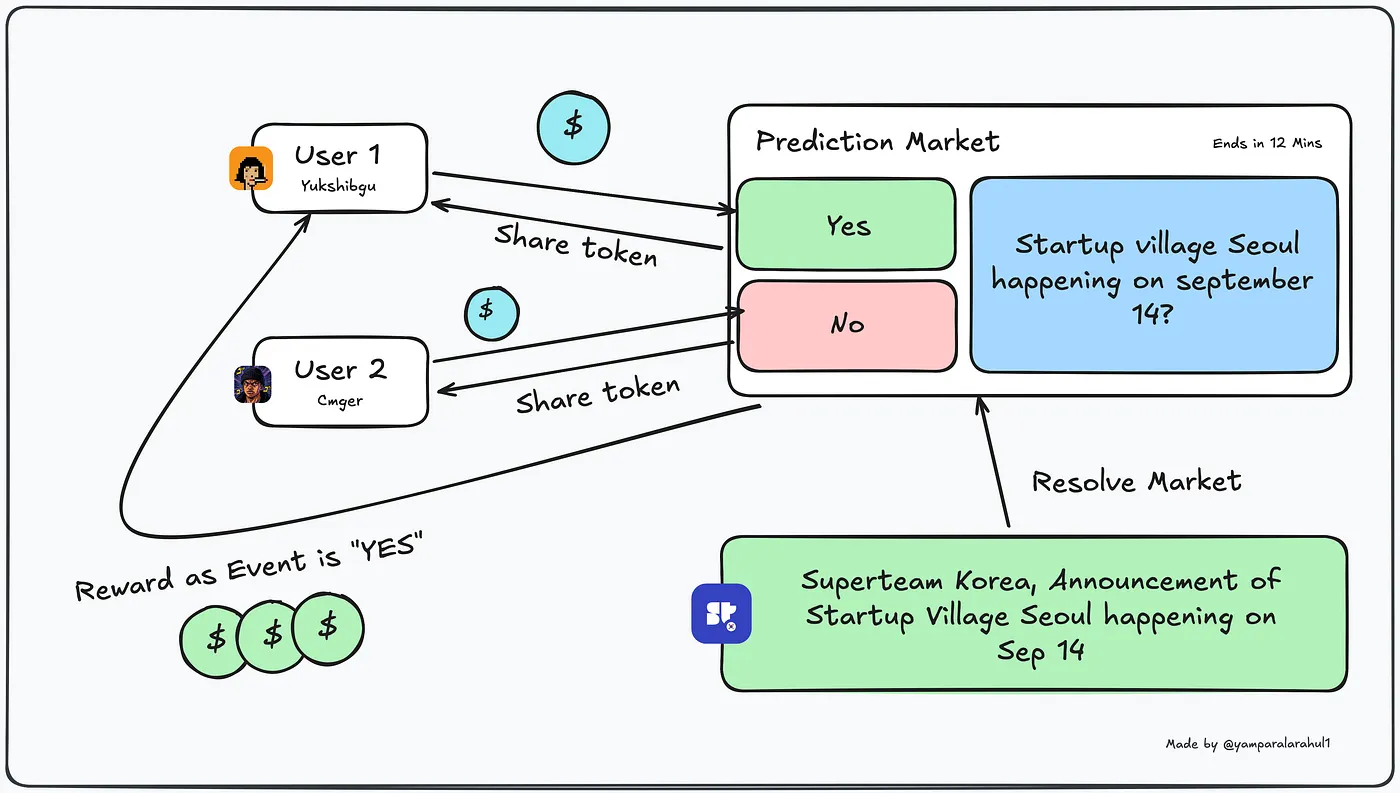
<figure><img src="https://4242579099-files.gitbook.io/~/files/v0/b/gitbook-x-prod.appspot.com/o/spaces%2Frrll8DWDA3BJwEBqOtxm%2Fuploads%2FtU0RMpBNVmA7F8yDL0WY%2Fimage.png?alt=media&#x26;token=1fdf7fd7-fdbb-4861-b806-0c44405a4415" alt="" width="563"><figcaption><p>General View of Prediction market <a href="https://medium.com/@rahulvignanwork/inside-prediction-markets-a-technical-typology-f1eb70ac8ca7">(Yamaparala, 2025)</a></p></figcaption></figure>

### **About Prediction Markets**

A **prediction market** acts as a decentralized mechanism to aggregate dispersed information, allowing participants to trade contracts whose values depend on the outcomes of uncertain future events. In blockchain-based environments, these markets convert collective beliefs into market prices that closely reflect real world probabilities while ensuring transparency, auditability, and automated enforcement through smart contracts (*The Rise of Blockchain-Based Prediction Markets*, 2024). Recent theoretical research highlights advancements in decentralized prediction system design, particularly through automated market maker (AMM) models that enhance liquidity, mitigate slippage, and reduce vulnerability to front-running (Wang, 2023).&#x20;

Within the decentralized finance (DeFi) ecosystem, three key actions define the market lifecycle - definitions are provided below.&#x20;

### **Definitions**

<table><thead><tr><th width="196.0390625">Job Offering Type</th><th width="187.97265625">Term</th><th>Description</th></tr></thead><tbody><tr><td>Create Market</td><td>Create Market</td><td>Setting up a new prediction market by defining the event, outcomes, resolution criteria, and end date. </td></tr><tr><td>Place Bet</td><td>Place Bet</td><td>Buying a position (shares/contracts) on a specific outcome in a prediction market. You pay the current market price for shares that will be worth $(bet amount) if your prediction is correct, or $0 if wrong.</td></tr><tr><td>Close Position</td><td>Sell</td><td>Closing or transferring your position before the event resolves; locks in profit or loss</td></tr><tr><td></td><td>Terminate</td><td>Ending your exposure before settlement, either by selling, exiting, or platform action. (Given that this is uncommon, it is not mentioned in the article for now)</td></tr><tr><td></td><td>Settle</td><td>Final contract payout when the event is officially resolved; profits/losses are locked in</td></tr></tbody></table>

### **References**

* The Rise of Blockchain-Based Prediction Markets. (2024, September). *California Management Review.* Retrieved from [https://cmr.berkeley.edu/2024/09/the-rise-of-blockchain-based-prediction-markets/](https://cmr.berkeley.edu/2024/09/the-rise-of-blockchain-based-prediction-markets/?utm_source=chatgpt.com)
* Wang, Y. (2023). *Automated Market Makers and the Design of Decentralized Prediction Systems.* In *Lecture Notes in Operations Research and Computational Humanities* (pp. 215–229). Springer. Retrieved from [https://ideas.repec.org/h/spr/lnopch/978-3-031-18679-0\_12.html](https://ideas.repec.org/h/spr/lnopch/978-3-031-18679-0_12.html?utm_source=chatgpt.com)


---

# Agent Instructions: Querying This Documentation

If you need additional information that is not directly available in this page, you can query the documentation dynamically by asking a question.

Perform an HTTP GET request on the current page URL with the `ask` query parameter:

```
GET https://whitepaper.virtuals.io/acp/introducing-acp-v2/acp-v2-prediction-market-use-case/prediction-markets-a-primer.md?ask=<question>
```

The question should be specific, self-contained, and written in natural language.
The response will contain a direct answer to the question and relevant excerpts and sources from the documentation.

Use this mechanism when the answer is not explicitly present in the current page, you need clarification or additional context, or you want to retrieve related documentation sections.
